ZMR Tech Solutions

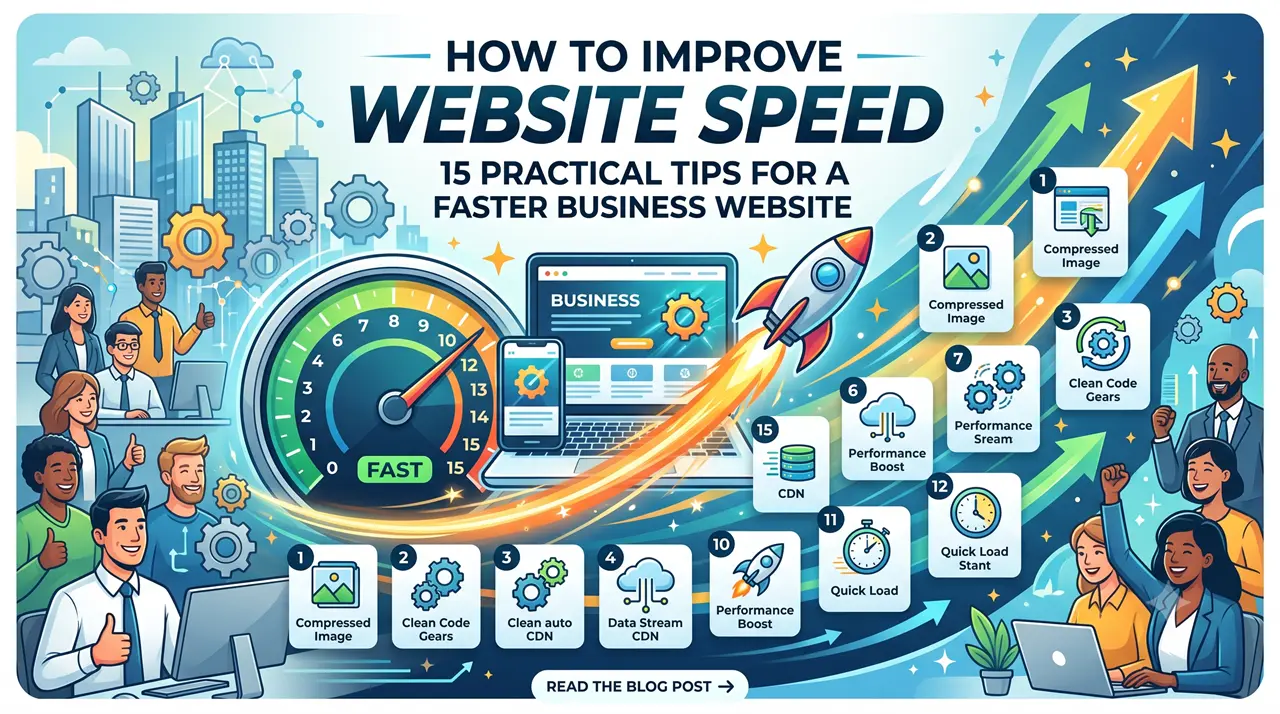
How to Improve Website Speed: 15 Practical Tips for a Faster Business Website

How to Improve Website Speed: 15 Practical Tips for a Faster Business Website

A fast website is no longer optional for a business. Whether you run a small local business, an eCommerce store, a service company, a coaching website, or a professional portfolio, website speed directly affects user experience, search visibility, and customer trust.

Imagine a potential customer searching for your service on Google. They click your website, but the page takes too long to open. Instead of waiting, they go back to Google and visit another website.

You may lose a customer even before they see your products or services.

This is why every business should focus on creating a website that is fast, mobile-friendly, secure, and easy to use.

In this guide, we will explain 15 practical ways to improve website speed without making the process unnecessarily complicated.

Why Website Speed Matters for Your Business

Website speed means how quickly your website loads and becomes usable for visitors.

A slow website can create several problems:

  • Visitors leave before viewing your content.
  • Your website may receive fewer enquiries.
  • Users may not complete purchases.
  • Mobile visitors may face a poor experience.
  • Search engine performance may be affected.
  • Your business may look less professional.
  • Paid advertising campaigns may become less effective.

A fast website creates a better first impression. It helps visitors find information quickly and makes it easier for them to contact your business.

For example, if your website promotes website development services, the website itself should load quickly. Otherwise, visitors may question the quality of your service.

How to Check Your Website Speed

Before improving website speed, you should first check the current performance of your website.

You can use tools such as:

  • Google PageSpeed Insights
  • GTmetrix
  • WebPageTest
  • Chrome Lighthouse

These tools can help identify problems related to:

  • Large images
  • Slow server response
  • Unused CSS and JavaScript
  • Render-blocking resources
  • Poor mobile performance
  • Caching issues
  • Slow loading fonts
  • Layout shifting

Do not focus only on the final score. A website with a slightly lower score can still provide a good user experience if the important content loads quickly.

The main goal should be to make the website faster for real visitors.

1. Choose Reliable Website Hosting

Hosting plays an important role in website performance.

Even if your website design is excellent, poor hosting can make the website slow. Low-quality hosting may have limited server resources, slow response time, and frequent performance issues.

When choosing hosting, consider:

  • Server response time
  • Available RAM and CPU resources
  • SSD or NVMe storage
  • Server location
  • Website backup options
  • Security features
  • Support quality
  • Scalability

For a local Indian business, hosting with a suitable server location and reliable infrastructure can help improve loading performance for the target audience.

Do not choose hosting only because it is cheap. A slow website can cost more in lost customers than the amount saved on hosting.

2. Optimize Website Images

Images are one of the most common reasons for slow websites.

Many websites upload large images directly from a camera or design software. A single image may be several megabytes in size, which increases loading time.

Before uploading images:

  • Resize them according to the display size.
  • Compress them without losing visible quality.
  • Use the correct file format.
  • Avoid uploading unnecessarily large images.
  • Remove unused images from the media library.

For example, if an image is displayed at 800 pixels wide, there is usually no need to upload a 5000-pixel-wide image.

Image optimization can significantly improve website performance, especially on mobile devices.

3. Use Modern Image Formats

Traditional image formats such as JPG and PNG are still useful, but modern formats can reduce file size further.

Common modern formats include:

  • WebP
  • AVIF

WebP is widely supported and is a practical choice for most websites. AVIF can provide even better compression in suitable situations.

Use JPG for many standard photographs, PNG when transparency is required, and WebP or AVIF when supported by your website setup.

The important thing is to maintain a balance between image quality and file size.

4. Enable Browser Caching

Browser caching allows a visitor’s browser to store certain website files locally.

When the visitor opens the website again, the browser may not need to download every file from the server. This can make repeat visits faster.

Cached files may include:

  • Logos
  • CSS files
  • JavaScript files
  • Fonts
  • Images
  • Other static resources

Caching can be configured through your hosting panel, caching plugin, server settings, or website optimization system.

For WordPress websites, caching plugins can make this process easier.

5. Use a Content Delivery Network

A Content Delivery Network, commonly called a CDN, stores and delivers website files through servers located in different regions.

When someone visits your website, files can be delivered from a server that is geographically closer to the visitor.

A CDN can help improve the delivery of:

  • Images
  • CSS files
  • JavaScript files
  • Fonts
  • Videos and other static content

A CDN is especially useful when your website receives visitors from different cities or countries.

For example, a website serving customers in India, the UAE, Europe, and America may benefit from a properly configured CDN.

6. Reduce Unnecessary WordPress Plugins

WordPress plugins provide useful features, but installing too many plugins can affect performance.

Some plugins load CSS and JavaScript files on every page, even when their features are not being used.

Review your plugins regularly and remove:

  • Unused plugins
  • Duplicate plugins
  • Outdated plugins
  • Plugins with overlapping features
  • Poorly coded plugins

Before deleting a plugin, check whether any important website feature depends on it.

A smaller number of reliable plugins is usually better than a large number of unnecessary plugins.

7. Minify CSS, JavaScript, and HTML

Minification removes unnecessary characters from website code without changing its functionality.

These unnecessary characters may include:

  • Extra spaces
  • Line breaks
  • Comments
  • Unused formatting characters

Minifying CSS, JavaScript, and HTML can reduce file sizes and help browsers download resources faster.

However, minification should be tested carefully. Some websites may experience layout or functionality problems if certain files are combined or modified incorrectly.

Always keep a backup before making major optimization changes.

8. Remove Unused CSS and JavaScript

Many websites load files that are not required on every page.

For example:

  • A contact form script may load on pages without a contact form.
  • A slider script may load on pages without a slider.
  • An eCommerce script may load on informational pages.
  • A popup script may load even when no popup is displayed.

Removing or conditionally loading unnecessary files can reduce page weight.

This type of optimization is especially useful for websites built with multiple plugins, page builders, tracking tools, and third-party integrations.

9. Improve Mobile Website Speed

A large number of users browse websites through smartphones.

A website that looks good on desktop may still be slow or difficult to use on mobile devices.

Check the following:

  • Text should be readable without zooming.
  • Buttons should be easy to tap.
  • Images should fit the screen.
  • Menus should work properly.
  • Sections should not overflow horizontally.
  • Popups should not cover the entire screen.
  • Important content should load quickly.

Avoid using unnecessarily heavy animations, large background videos, and oversized images on mobile devices.

A mobile-first approach helps create a better experience for users with slower connections or limited devices.

10. Optimize Website Fonts

Custom fonts can improve website appearance, but too many font files can slow down loading.

A website may load multiple font families, weights, and styles that are not actually needed.

For better performance:

  • Use a limited number of font families.
  • Load only the required font weights.
  • Avoid unnecessary font variations.
  • Use modern font formats where possible.
  • Consider system fonts for selected sections.
  • Make sure text remains visible while fonts load.

A professional website does not need many different fonts. A clean font combination usually looks better and loads faster.

11. Reduce Redirects

A redirect sends visitors from one URL to another URL.

Redirects are sometimes necessary, but too many redirects can increase loading time.

For example, a visitor may be redirected through several versions of a URL before reaching the final page.

Review unnecessary redirects and make sure:

  • Internal links point directly to the correct URL.
  • HTTP redirects to HTTPS are configured properly.
  • Old pages redirect to relevant new pages.
  • Redirect chains are avoided.
  • Broken links are fixed.

A clean website structure improves both user experience and search engine crawling.

12. Optimize the Website Database

For WordPress websites, the database stores posts, pages, settings, comments, plugin data, and other information.

Over time, the database may collect unnecessary data such as:

  • Post revisions
  • Spam comments
  • Deleted content
  • Temporary options
  • Unused plugin data
  • Expired transient data

Regular database maintenance can help keep the website organized.

Before cleaning the database, always create a complete backup. Incorrect database changes can affect important website functionality.

13. Avoid Too Many Third-Party Scripts

Third-party scripts are commonly used for:

  • Analytics
  • Chat widgets
  • Social media feeds
  • Advertising
  • Heatmaps
  • Marketing automation
  • Video embeds
  • Review widgets

These tools can be useful, but every external script may add extra loading work.

Use only the tools that are genuinely required for your business.

You can also improve performance by:

  • Loading scripts only when needed.
  • Delaying non-essential scripts.
  • Removing unused tracking codes.
  • Avoiding multiple tools with the same purpose.
  • Loading chat widgets after the main content.

Do not remove important tracking or security scripts without understanding their purpose.

14. Improve Core Web Vitals

Core Web Vitals are performance measurements that focus on important aspects of user experience.

They mainly evaluate:

Largest Contentful Paint

This measures how quickly the main content becomes visible.

A large hero image, slow server, or heavy page builder section can affect this measurement.

Interaction to Next Paint

This measures how quickly a page responds after a user interacts with it.

Heavy JavaScript and excessive third-party scripts can create delays.

Cumulative Layout Shift

This measures unexpected movement of page elements while loading.

Layout shifts may happen when:

  • Images do not have fixed dimensions.
  • Advertisements load late.
  • Fonts change the layout.
  • Popups push content down.
  • Sections load at different times.

To improve Core Web Vitals, focus on real user experience rather than only trying to achieve a perfect score.

15. Monitor Website Performance Regularly

Website speed is not a one-time task.

A website that is fast today may become slow later because of:

  • New plugins
  • More images
  • New tracking scripts
  • Hosting changes
  • Theme updates
  • Database growth
  • Additional website features

Create a regular website performance checklist.

At least once a month, check:

  • Homepage loading speed
  • Mobile performance
  • Important service pages
  • Contact page
  • Product pages
  • Blog pages
  • Broken links
  • Security warnings
  • Server response time
  • Website backups

Regular monitoring helps you identify problems before they affect customers.

Common Website Speed Mistakes to Avoid

Many business websites become slow because of small mistakes.

Avoid the following:

  • Uploading large images directly from a camera.
  • Using too many animations.
  • Installing unnecessary plugins.
  • Using multiple popup tools.
  • Adding too many fonts.
  • Embedding large videos on the homepage.
  • Using cheap and overloaded hosting.
  • Ignoring mobile optimization.
  • Loading social media feeds everywhere.
  • Using outdated themes and plugins.
  • Adding unnecessary code to every page.
  • Not testing the website after updates.

A fast website is usually the result of many small improvements working together.

Website Speed Optimization Checklist

Use this checklist to review your website:

  • Website hosting is reliable.
  • Images are compressed.
  • Modern image formats are used.
  • Browser caching is enabled.
  • CDN is configured where required.
  • Unused plugins are removed.
  • CSS and JavaScript are optimized.
  • Mobile layout works properly.
  • Fonts are limited and optimized.
  • Redirect chains are removed.
  • Database is maintained.
  • Third-party scripts are reviewed.
  • Core Web Vitals are monitored.
  • Website backups are available.
  • Website speed is tested regularly.

Frequently Asked Questions

How fast should a business website load?

A business website should become usable as quickly as possible. The exact loading time depends on the website type, hosting, content, and visitor’s internet connection. Focus on fast loading of the main content and a smooth user experience.

Does website speed affect SEO?

Yes. Website speed and user experience are important parts of modern website optimization. A slow website may also create a poor experience, which can affect engagement and conversions.

Can a WordPress website be made faster?

Yes. WordPress websites can often be improved through better hosting, image optimization, caching, plugin management, code optimization, and mobile performance improvements.

Does changing hosting improve website speed?

Changing hosting can improve speed if the existing hosting has poor server response time or limited resources. However, hosting alone may not solve problems caused by large images, heavy plugins, or inefficient code.

Is a speed optimization plugin enough?

A speed optimization plugin can help, but it is not always enough. Website speed also depends on hosting, website structure, images, plugins, theme, scripts, and database performance.

Should every website use a CDN?

Not every small website needs a CDN, but it can be useful for websites with visitors from different locations or websites that deliver many static files.

How often should website speed be checked?

You should check website speed at least once a month and after major changes such as plugin updates, theme changes, redesigns, or adding new features.

Final Thoughts

Website speed is an important part of professional website development. It affects how visitors experience your website, how they interact with your content, and whether they contact your business.

You do not always need a complete redesign to improve website performance. In many cases, better hosting, optimized images, caching, fewer plugins, mobile improvements, and cleaner code can make a noticeable difference.

If your website is slow, do not ignore the problem. A faster website can help improve user experience, support SEO efforts, and increase the chances of turning visitors into customers.

At ZMR Tech Solutions, we help businesses build, redesign, and optimize professional websites that are fast, mobile-friendly, secure, and designed for business growth.

Our services include:

  • Website Design and Development
  • WordPress Website Development
  • Custom Website Development
  • eCommerce Website Development
  • Website Speed Optimization
  • SEO Services
  • Digital Marketing
  • Website Maintenance
  • Hosting and SSL Setup

You can contact us for a FREE Website Audit and a practical strategy to improve your website’s performance.

Ready to make your website faster and more effective? Contact ZMR Tech Solutions today.
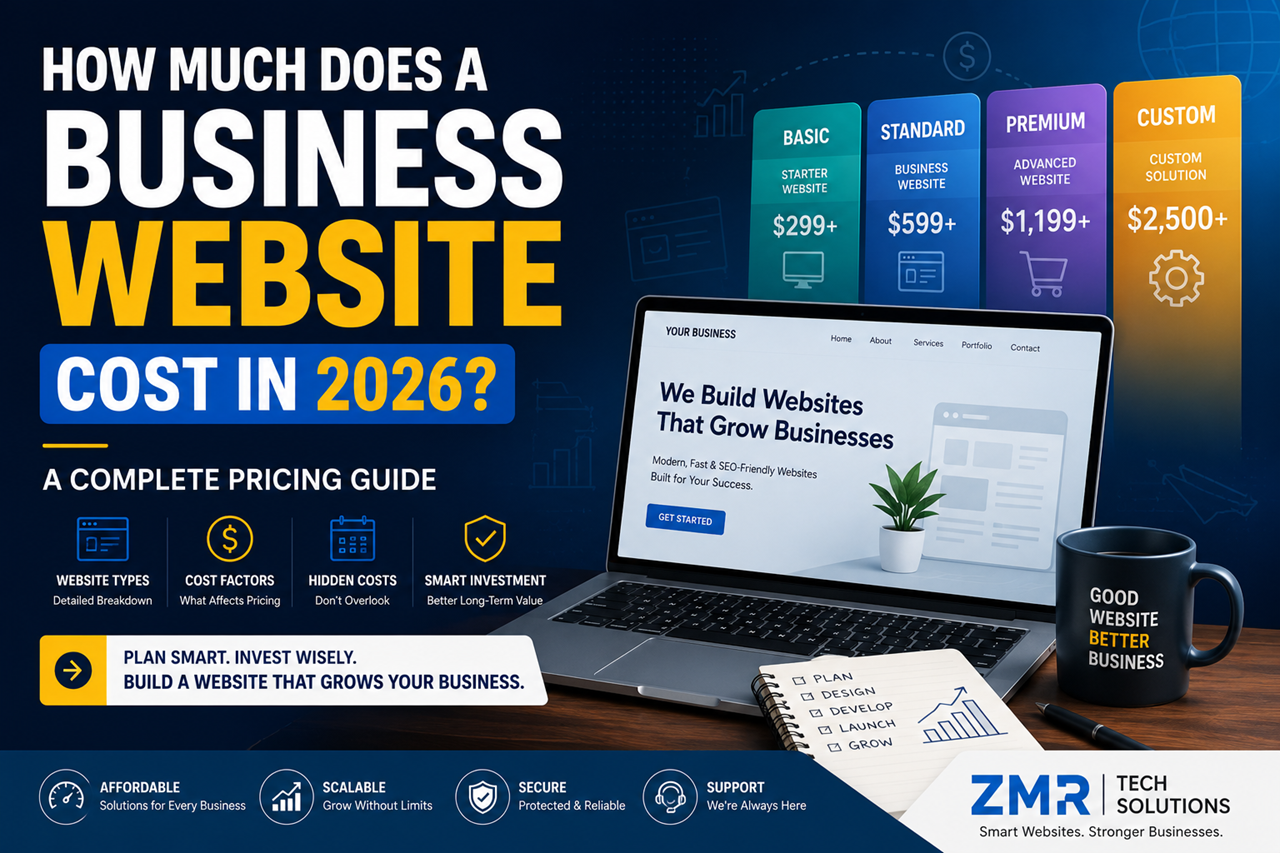
How Much Does a Business Website Cost ? A Complete Pricing Guide

How Much Does a Business Website Cost in ? A Complete Pricing Guide

If you’re planning to create a website for your business, one of the first questions that comes to mind is:

“How much will it cost?”

The answer isn’t as simple as giving a single number. Website pricing depends on several factors, including the type of website, the features you need, the platform you choose, and the company you hire.

Some businesses only need a professional online presence, while others require online booking, eCommerce, customer dashboards, or custom software integrations.

The good news is that you don’t have to overspend to get a high-quality website. By understanding what affects website pricing, you can make a smarter investment and avoid paying for features you don’t need.

In this guide, we’ll explain everything in simple English so you can confidently plan your website budget.


Table of Contents

  1. Why Website Costs Vary
  2. Factors That Affect Website Pricing
  3. Types of Business Websites
  4. WordPress Website Cost
  5. Custom Website Cost
  6. eCommerce Website Cost
  7. Hidden Costs to Consider
  8. How to Choose the Right Website
  9. FAQs
  10. Final Thoughts

Why Website Costs Are Different

Many business owners compare websites the same way they compare products in a store.

But websites are different.

A website is more like building a house.

A small one-bedroom house costs less than a large luxury villa because the size, materials, design, and features are completely different.

The same applies to websites.

A simple five-page company website will naturally cost less than a large online store with hundreds of products or a custom business portal.

Instead of asking:

“What’s the cheapest website?”

Ask yourself:

“What kind of website does my business actually need?”

That simple question can save you money and help you make a better long-term decision.


What Affects the Cost of a Website?

Several factors influence the final price of a website.

1. Number of Pages

A website with five pages is easier and faster to build than one with fifty pages.

More pages mean more design work, content, testing, and optimization.


2. Design Requirements

A template-based design usually costs less.

A fully custom design created specifically for your brand requires more planning, creativity, and development time.


3. Features and Functionality

Basic websites may only include:

  • Home
  • About
  • Services
  • Contact
  • Blog

Advanced websites may include:

  • Appointment booking
  • Payment gateway
  • Customer dashboard
  • Membership system
  • CRM integration
  • Live chat
  • Multi-language support
  • API integrations

Every additional feature adds to the overall project cost.


4. Content Creation

If you already have professional content and images, your project may cost less.

If the agency needs to create:

  • Website copy
  • Graphics
  • Icons
  • Banners
  • SEO content

the total investment will be higher.


5. SEO

A website without SEO is like opening a shop in the middle of a desert.

Basic SEO usually includes:

  • Meta titles
  • Meta descriptions
  • Image optimization
  • Mobile optimization
  • Page speed improvements
  • Sitemap
  • Technical SEO setup

Investing in SEO from the beginning can help your website attract visitors more effectively.


6. Hosting and Domain

Every website needs:

  • Domain name
  • Web hosting
  • SSL certificate

These are recurring yearly costs and should be included in your overall website budget.

7. WordPress Website Cost

WordPress is one of the most affordable and flexible platforms for business websites. It is suitable for startups, local businesses, service providers, consultants, and even eCommerce stores.

A typical WordPress website usually includes:

  • Professional design
  • Mobile-friendly layout
  • Contact forms
  • Blog
  • Basic SEO
  • Security setup
  • SSL integration
  • Speed optimization

The final cost depends on the number of pages, custom features, premium plugins, and design requirements.

When Should You Choose WordPress?

WordPress is a great choice if you:

  • Want a professional website quickly.
  • Have a limited budget.
  • Need an easy-to-manage website.
  • Plan to publish blogs regularly.
  • Want strong SEO capabilities.

For most small and medium-sized businesses, WordPress provides excellent value without compromising on quality.


8. Custom Website Cost

A custom website is designed and developed specifically for your business. Every feature, layout, and function is built according to your requirements.

Custom websites are commonly used for:

  • Large companies
  • SaaS platforms
  • Business portals
  • Membership websites
  • Booking systems
  • CRM-based applications
  • Marketplace platforms

Because everything is built from scratch, development takes more time and usually requires a higher investment.

Benefits of a Custom Website

  • Unique design
  • Better flexibility
  • Advanced functionality
  • Easier integration with business systems
  • Long-term scalability

If your website plays a central role in your business operations, investing in a custom solution can be worthwhile.


9. eCommerce Website Cost

Selling products online involves more than just displaying items.

An eCommerce website may include:

  • Product catalog
  • Shopping cart
  • Secure checkout
  • Payment gateway
  • Order management
  • Inventory management
  • Shipping integration
  • Customer accounts
  • Discount coupons

The overall cost depends on:

  • Number of products
  • Payment methods
  • Shipping rules
  • Custom features
  • Third-party integrations

Instead of focusing only on the initial cost, consider how the website will support your sales and customer experience over time.


10. Hidden Costs You Shouldn’t Ignore

Many businesses only think about the cost of designing a website.

However, there are other ongoing expenses to consider.

Domain Renewal

Your domain name must be renewed every year.


Web Hosting

Reliable hosting keeps your website fast, secure, and available to visitors.


SSL Certificate

An SSL certificate protects customer data and helps build trust.


Website Maintenance

Regular maintenance includes:

  • Updates
  • Backups
  • Security monitoring
  • Performance optimization
  • Bug fixes

Ignoring maintenance can lead to security issues and poor website performance.


SEO and Content Marketing

Building a website is only the beginning.

To attract new visitors, you should continue investing in:

  • Blog writing
  • SEO
  • Local SEO
  • Content updates
  • Landing pages

These ongoing efforts help improve your visibility in search engines and generate more business opportunities.


How to Choose the Right Website for Your Business

Before requesting a quote, ask yourself these questions:

What is the purpose of my website?

Do you want to:

  • Generate leads?
  • Sell products?
  • Build trust?
  • Share information?
  • Accept bookings?

Understanding your goal makes it easier to choose the right solution.


How much growth do I expect?

If your business is likely to expand in the next few years, choose a website that can grow with you.

Planning ahead often saves money in the long run.


Who will manage the website?

If you want to update content yourself, WordPress is an excellent option because it’s user-friendly.

If your website requires highly specialized features, a custom-built solution may be more appropriate.


Common Website Budget Mistakes

Avoid these common mistakes:

  • Choosing the cheapest option without checking quality.
  • Ignoring ongoing maintenance costs.
  • Forgetting SEO during development.
  • Selecting unnecessary features.
  • Hiring inexperienced developers.
  • Not planning for future growth.

A well-planned website is an investment, not just an expense.


Frequently Asked Questions

How much should a small business budget for a website?

The budget depends on your goals, required features, and design preferences. Focus on value rather than choosing the lowest price.

Why do website prices vary so much?

Every website is different. Design complexity, functionality, integrations, and content all affect the overall cost.

Is WordPress less expensive than a custom website?

In most cases, yes. WordPress websites usually require less development time, making them more affordable for many businesses.

Can I upgrade my website later?

Absolutely. Many businesses start with a basic website and add new features as they grow.

Is SEO included in every website package?

Not always. Some companies include basic SEO, while advanced SEO services are often offered separately. Always ask what’s included before making a decision.


Final Thoughts

A business website is one of the most valuable investments you can make.

Rather than asking, “What’s the cheapest website?”, ask “Which website will help my business grow?”

The right website should support your goals, represent your brand professionally, provide a great user experience, and make it easy for customers to contact you or buy from you.

By understanding the factors that influence website pricing, you can make a confident decision and invest in a solution that delivers long-term value.


Ready to Build a Website That Delivers Results?

Whether you need a professional WordPress website, a custom business website, or a fully featured eCommerce store, ZMR Tech Solutions can help.

We create modern, fast, secure, and SEO-friendly websites tailored to your business goals. Our team focuses on quality, performance, and long-term growth—so your website becomes more than just an online presence.

Contact ZMR Tech Solutions today for a free consultation and let’s build a website that helps your business grow with confidence.

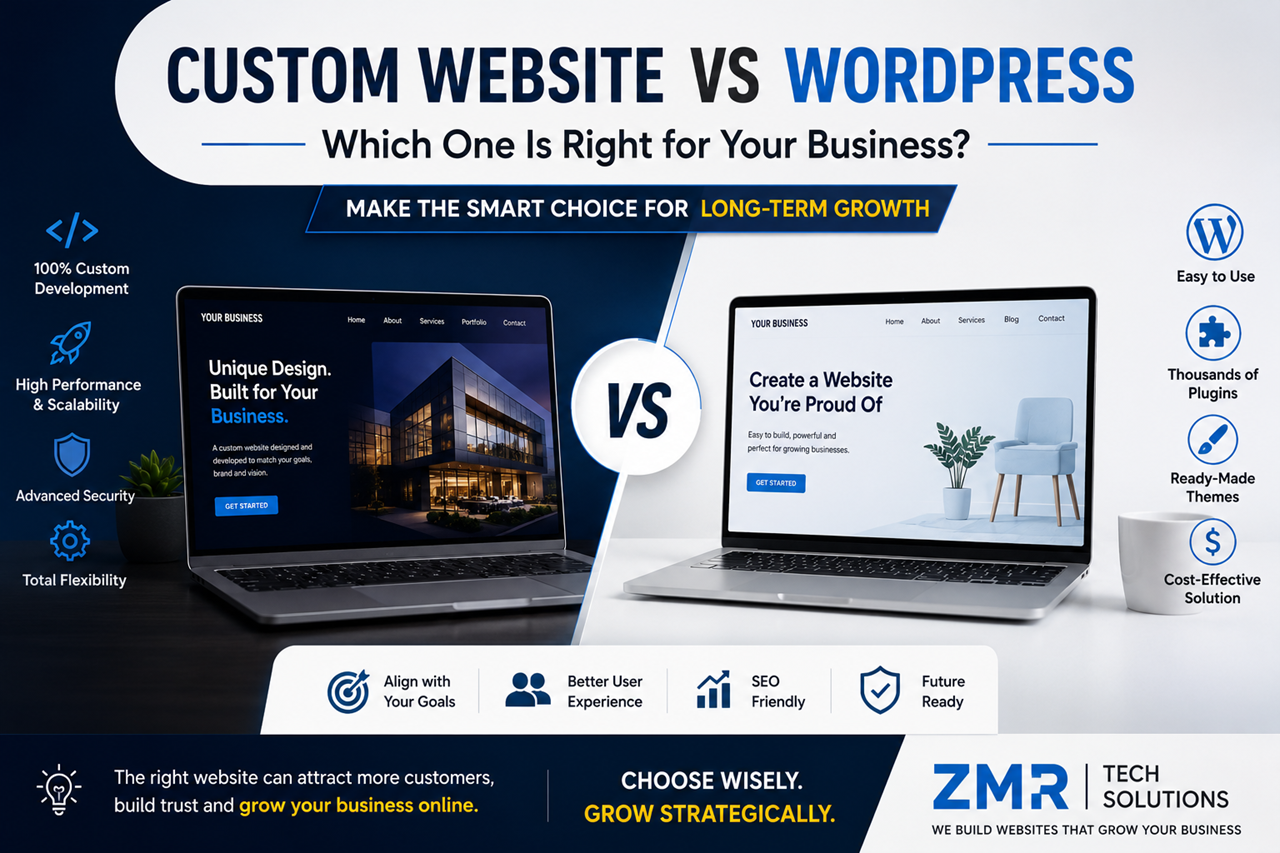
Custom Website vs WordPress: Which One Is Right for Your Business?

Custom Website vs WordPress: Which One Is Right for Your Business?

When planning a new website, one of the first questions business owners ask is:

“Should I choose WordPress or invest in a custom website?”

It’s a fair question—and the answer depends on your business goals, budget, and future plans.

Some businesses need a website they can launch quickly with a limited budget. Others need advanced features, custom workflows, and the flexibility to scale as they grow.

The good news is that both WordPress and custom websites can help your business succeed. The key is understanding which solution fits your needs today and can support your growth tomorrow.

In this guide, we’ll explain the differences in simple, easy-to-understand language so you can make an informed decision without getting lost in technical jargon.


Table of Contents

  1. What Is WordPress?
  2. What Is a Custom Website?
  3. Key Differences Between WordPress and Custom Websites
  4. Design & Branding
  5. Performance & Speed
  6. SEO Capabilities
  7. Security
  8. Scalability
  9. Cost Comparison
  10. Maintenance
  11. Which One Should You Choose?
  12. FAQs
  13. Final Thoughts

What Is WordPress?

WordPress is the world’s most popular Content Management System (CMS), powering millions of websites across industries. It allows businesses to create professional websites without building everything from scratch.

With thousands of themes and plugins available, WordPress makes it easy to launch websites for:

  • Small businesses
  • Service providers
  • Bloggers
  • Corporate websites
  • Online stores
  • Educational websites
  • Portfolios

One of the biggest advantages of WordPress is flexibility. You can start with a simple website and expand it as your business grows.

For many businesses, WordPress offers the perfect balance between affordability and functionality.


What Is a Custom Website?

A custom website is built specifically for your business from the ground up.

Instead of relying on pre-made themes or plugins, every page, feature, and functionality is designed around your unique requirements.

For example, if your company needs:

  • A custom booking system
  • Advanced CRM integration
  • Customer dashboards
  • Multi-vendor functionality
  • Unique business workflows

A custom-built website gives developers complete control over how everything works.

Although custom development usually costs more, it offers unmatched flexibility for businesses with specific needs.


WordPress vs Custom Website: The Key Difference

The easiest way to understand the difference is this:

Think of WordPress as buying a fully furnished apartment.

It’s ready to move into, cost-effective, and can be customized to suit your style.

A custom website, on the other hand, is like building your own house from the ground up.

You choose the layout, the design, the materials, and every feature based on your exact requirements.

Neither option is better for everyone.

The right choice depends entirely on your business goals.


Design & Branding

Your website represents your brand.

If it looks outdated or generic, visitors may lose confidence before reading a single line of content.

WordPress

Modern WordPress themes offer beautiful designs that can be customized with colors, fonts, layouts, and branding.

For many businesses, this level of customization is more than enough.

Custom Website

A custom website gives designers complete creative freedom.

Every section can be designed specifically for your audience and your brand identity.

If your business wants to stand out in a competitive market, custom design provides a unique experience that template-based websites often can’t match.


Performance & Speed

Website speed affects both user experience and search engine rankings.

A fast website keeps visitors engaged and improves the chances they’ll contact your business.

WordPress

A well-optimized WordPress website can deliver excellent performance.

However, installing too many plugins, using oversized images, or choosing poor-quality hosting can slow it down.

Custom Website

A custom-built website contains only the code needed for your business.

Because unnecessary features aren’t included, custom websites can often load faster and perform better under heavy traffic.

That said, performance still depends on the quality of development and hosting.


SEO Capabilities

One of the biggest myths is that custom websites automatically rank better than WordPress.

The truth is different.

Search engines don’t rank websites based on the platform they use.

They rank websites based on factors such as:

  • High-quality content
  • Fast loading speed
  • Mobile responsiveness
  • User experience
  • Technical SEO
  • Website security
  • Helpful information

Both WordPress and custom websites can achieve excellent search engine rankings when built correctly and supported by a strong SEO strategy.

7. Security: Which Platform Is Safer?

Security is one of the biggest concerns for any business website. Whether you collect customer information, process inquiries, or accept online payments, protecting your website should always be a priority.

Many people believe that WordPress is not secure. The truth is a little different.

WordPress itself is regularly updated and is considered secure when maintained properly. Most security issues happen because websites use outdated plugins, weak passwords, or poorly coded themes.

WordPress Security

A well-maintained WordPress website can be highly secure if you:

  • Keep WordPress updated.
  • Update plugins and themes regularly.
  • Use strong passwords.
  • Install a trusted security plugin.
  • Enable SSL (HTTPS).
  • Take regular backups.

Custom Website Security

A custom website doesn’t rely on third-party plugins as much, which can reduce some security risks.

However, security depends entirely on how the website is developed. Poor coding practices can create vulnerabilities just as easily as outdated plugins.

Winner: It’s a tie. Both platforms can be very secure when built and maintained correctly.


8. Scalability: Can Your Website Grow with Your Business?

Your business today may look very different in two or three years.

That’s why it’s important to choose a platform that can grow with you.

WordPress

WordPress is highly scalable for most businesses.

You can start with a simple website and later add features such as:

  • Online booking
  • Blog
  • WooCommerce store
  • Membership area
  • Live chat
  • CRM integration
  • Marketing automation

For many small and medium-sized businesses, WordPress offers all the scalability they’ll ever need.

Custom Website

A custom website offers virtually unlimited flexibility.

If your business requires complex workflows, custom dashboards, advanced reporting, or enterprise-level systems, custom development is often the better choice.

Winner: Custom Website (for complex business requirements).


9. Cost Comparison

Budget is often one of the biggest deciding factors.

Let’s compare the typical costs.

WordPress Website

A professional WordPress website usually includes:

  • Domain name
  • Hosting
  • Premium theme (optional)
  • Plugins
  • Website design
  • Development
  • Basic SEO

This makes WordPress an excellent option for startups and growing businesses.

Custom Website

A custom website requires everything to be designed and developed specifically for your business.

The cost depends on:

  • Number of pages
  • Features
  • Integrations
  • User roles
  • Dashboard requirements
  • APIs
  • Testing
  • Future scalability

While the investment is higher, businesses with unique requirements often benefit from the additional flexibility.

Tip: Don’t choose the cheapest option. Choose the solution that supports your business goals for the next three to five years.


10. Maintenance

Launching your website is only the beginning.

Regular maintenance keeps your website secure, fast, and reliable.

WordPress Maintenance

Maintenance usually includes:

  • WordPress updates
  • Plugin updates
  • Theme updates
  • Backups
  • Security monitoring
  • Performance optimization

Custom Website Maintenance

Custom websites also require maintenance.

Developers may need to:

  • Update server software
  • Fix bugs
  • Improve performance
  • Add new features
  • Maintain integrations

Every website—regardless of the platform—needs ongoing care.


Pros and Cons

WordPress

Pros

  • Lower development cost
  • Faster launch
  • Easy content management
  • Thousands of plugins
  • Large community support
  • Excellent for SEO

Cons

  • Requires regular updates
  • Too many plugins can affect performance
  • Advanced custom features may require additional development

Custom Website

Pros

  • Completely unique design
  • Built around your business
  • Greater flexibility
  • Better for complex systems
  • Highly scalable

Cons

  • Higher initial investment
  • Longer development time
  • Requires experienced developers
  • Future updates usually need development support

Which Businesses Should Choose WordPress?

WordPress is ideal for:

  • Small businesses
  • Local service providers
  • Consultants
  • Digital agencies
  • Schools
  • Restaurants
  • Healthcare clinics
  • Real estate agencies
  • Corporate websites
  • Online stores

If your goal is to launch quickly, manage content easily, and stay within budget, WordPress is an excellent choice.


Which Businesses Should Choose a Custom Website?

A custom website is a better option for businesses that need:

  • Custom business workflows
  • Enterprise software integration
  • Advanced customer dashboards
  • Multi-vendor marketplaces
  • Membership platforms
  • Large-scale web applications
  • Unique user experiences

If your website is central to how your business operates, custom development can provide greater long-term value.


Common Mistakes to Avoid

Many businesses make these mistakes when choosing a website platform:

  • Choosing based only on price
  • Ignoring future growth
  • Selecting features they don’t actually need
  • Forgetting maintenance costs
  • Choosing an inexperienced developer
  • Not planning for SEO from the beginning

The best website isn’t the most expensive one—it’s the one that solves your business problems and supports your goals.


Frequently Asked Questions

Is WordPress good for business websites?

Yes. WordPress powers millions of business websites and is suitable for most small and medium-sized companies.

Is a custom website better for SEO?

Not automatically. SEO depends on content quality, website speed, technical optimization, and user experience—not just the platform.

Which platform is more affordable?

WordPress generally has a lower initial cost, making it a popular choice for businesses with limited budgets.

Can I move from WordPress to a custom website later?

Yes. Many businesses start with WordPress and transition to a custom solution as their needs become more advanced.

Which option is better for long-term growth?

If your requirements are standard, WordPress can support years of growth. If your business depends on highly customized functionality, a custom website may be the better long-term investment.


Final Verdict

There is no universal “best” platform.

The right choice depends on your business goals, budget, timeline, and future plans.

Choose WordPress if you want a professional, SEO-friendly website that is cost-effective, easy to manage, and quick to launch.

Choose a Custom Website if your business requires advanced functionality, unique workflows, or enterprise-level scalability.

Instead of asking, “Which platform is better?”

Ask yourself:

“Which platform is better for my business?”

That question will help you make the right decision.


Ready to Build the Right Website?

Whether you choose WordPress or a fully custom solution, the most important factor is working with a team that understands your business goals.

At ZMR Tech Solutions, we build fast, secure, mobile-friendly, and SEO-optimized websites tailored to your business needs. From professional WordPress websites to fully custom web applications, we help businesses create a strong online presence that delivers real results.

Contact us today for a free consultation and let’s build a website that grows with your business.

10 Website Mistakes That Are Costing You Customers Part-2


6. Outdated Website Design

Your website doesn’t need to look flashy, but it should look modern and professional.

An outdated design can make visitors question your credibility. If your website looks like it hasn’t been updated in years, people may assume your business isn’t active or trustworthy.

Signs Your Website Needs a Redesign

  • Old-fashioned layout
  • Poor-quality images
  • Inconsistent fonts and colors
  • Cluttered pages
  • Difficult-to-read text

A clean and modern design helps visitors stay longer and builds confidence in your business.


7. Your Content Doesn’t Answer Customer Questions

Many business websites focus too much on talking about themselves instead of helping their visitors.

Your content should answer questions like:

  • What services do you offer?
  • How can you solve my problem?
  • Why should I choose your business?
  • How do I get started?

Write in simple English and avoid technical terms whenever possible. Your goal is to educate your readers, not confuse them.

Example

Instead of writing:

“We provide scalable digital infrastructure solutions.”

Write:

“We build fast, secure, and user-friendly websites that help businesses grow online.”

Clear and simple language creates a better experience for everyone.


8. Ignoring Basic SEO

Search Engine Optimization (SEO) helps people find your website through search engines.

Without basic SEO, even a great-looking website may never reach the right audience.

Some essential SEO practices include:

  • Writing unique page titles
  • Adding meta descriptions
  • Using proper headings (H1, H2, H3)
  • Optimizing images
  • Improving page speed
  • Creating helpful content
  • Adding internal links

SEO isn’t about tricking search engines—it’s about making your website useful for real people.


9. Your Contact Information Is Hard to Find

If customers can’t contact you easily, they may leave your website without taking any action.

Your contact details should be visible on every page.

Include:

  • Phone number
  • Email address
  • Contact form
  • Business location (if applicable)
  • Business hours
  • Social media links

The easier it is to contact you, the more inquiries you’re likely to receive.


10. Forgetting Regular Website Maintenance

A website needs regular care to perform well.

Ignoring updates can lead to slow performance, security risks, broken features, and poor user experience.

Create a simple monthly maintenance routine:

  • Update WordPress, themes, and plugins.
  • Back up your website.
  • Check for broken links.
  • Test forms and buttons.
  • Review website speed.
  • Scan for security issues.

Small maintenance tasks today can prevent bigger problems tomorrow.


Quick Website Checklist

Before you leave, ask yourself these simple questions:

✅ Does my website load quickly?

✅ Is it mobile-friendly?

✅ Can visitors easily find my services?

✅ Is my contact information visible?

✅ Does my website look modern?

✅ Do I have customer reviews or testimonials?

✅ Is my website secure?

✅ Am I updating my website regularly?

If you answered “No” to several of these questions, it’s a good time to improve your website.


Frequently Asked Questions

How often should I update my website?

Review your website every month and make updates whenever your business information, services, or pricing changes.

Can a slow website affect sales?

Yes. A slow website can frustrate visitors, reduce trust, and increase the chances of people leaving before contacting your business.

Why is mobile-friendly design important?

Most people browse websites on their phones. A responsive website provides a better experience and helps you reach more customers.

Do small businesses really need SEO?

Absolutely. SEO helps your website appear in search results, making it easier for potential customers to discover your business online.

How do I know if my website needs a redesign?

If your website looks outdated, loads slowly, isn’t mobile-friendly, or doesn’t generate inquiries, it may be time for a redesign.


Final Thoughts

Your website should do more than simply exist—it should help your business grow.

By fixing these common website mistakes, you can improve user experience, build trust, increase search visibility, and generate more leads.

Remember, even small improvements can make a big difference over time.

Instead of trying to fix everything at once, start with the most important issues. Regular updates and continuous improvements will keep your website performing at its best.


Ready to Improve Your Website?

Whether you’re launching a new business website, redesigning an existing one, or looking to improve speed, SEO, and user experience, ZMR Tech Solutions is here to help.

Our team creates modern, responsive, and SEO-friendly websites that are built to attract visitors, generate leads, and support long-term business growth.

Get in touch today for a free consultation and discover how the right website can help your business succeed online.

10 Website Mistakes That Are Costing You Customers Part-1

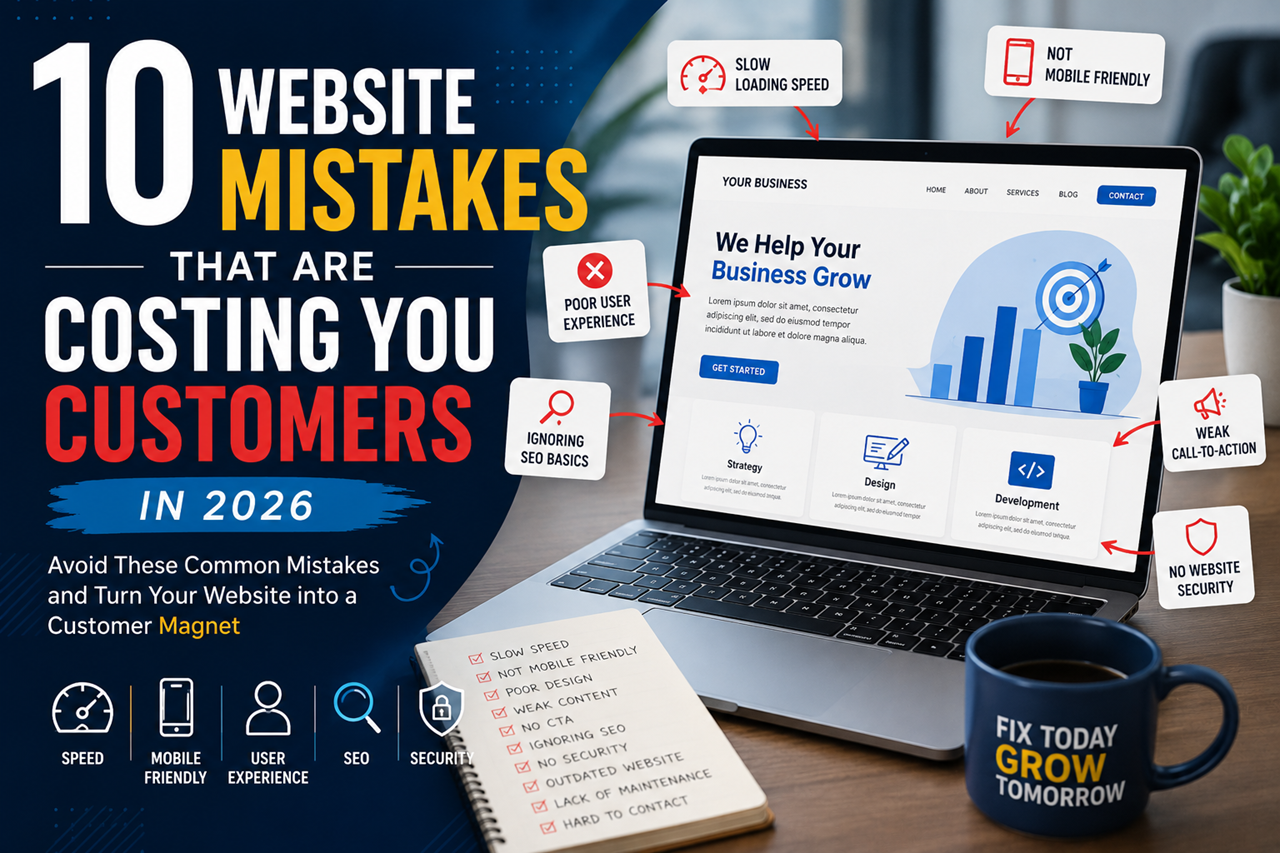
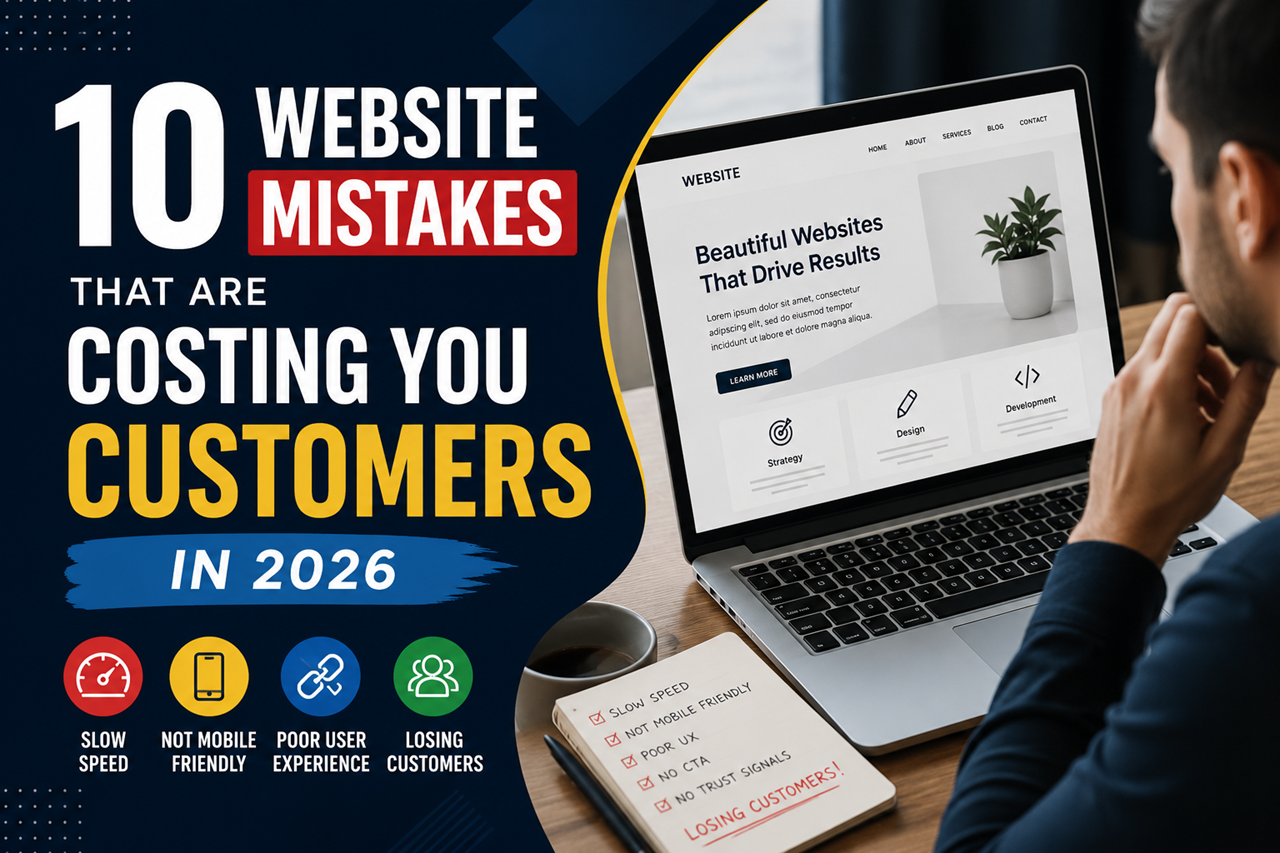
10 Website Mistakes That Are Costing You Customers

Your website is more than just an online presence—it’s often the first impression people have of your business.

Imagine visiting a website that takes forever to load, looks outdated, or makes it difficult to find contact information. Most people won’t wait. They’ll simply close the page and visit another business.

That’s exactly what can happen to your potential customers.

In 2026, customers expect websites to be fast, mobile-friendly, secure, and easy to use. If your website doesn’t meet these expectations, you could be losing valuable leads every single day without even realizing it.

The good news is that most website problems are easy to fix once you know what to look for.

In this guide, we’ll cover the ten most common website mistakes businesses make and show you how to avoid them.


1. Your Website Loads Too Slowly

Speed matters more than ever.

People expect websites to load almost instantly. If your pages take too long, visitors are likely to leave before they even see your products or services.

A slow website doesn’t just affect user experience—it can also reduce your search engine visibility and hurt your conversion rate.

Common Reasons for a Slow Website

  • Large image files
  • Low-quality web hosting
  • Too many plugins
  • Unoptimized code
  • Too many third-party scripts

How to Improve Website Speed

  • Compress images before uploading them.
  • Remove unnecessary plugins and features.
  • Choose reliable hosting.
  • Enable browser caching.
  • Keep your website updated.

Pro Tip: Test your website speed every month. Even small improvements can make a noticeable difference.


2. Your Website Isn’t Mobile-Friendly

Today, most website visitors use smartphones instead of desktop computers.

If your website doesn’t work well on mobile devices, you’re creating a frustrating experience for potential customers.

Common mobile issues include:

  • Tiny text that’s hard to read
  • Buttons that are difficult to tap
  • Images that don’t fit the screen
  • Slow loading on mobile networks

A responsive website automatically adjusts to different screen sizes, making it easier for visitors to browse your content.

Why Mobile Optimization Matters

A mobile-friendly website helps you:

  • Improve user experience
  • Increase engagement
  • Build customer trust
  • Reach more potential customers

3. Visitors Can’t Find What They’re Looking For

A beautiful website isn’t helpful if visitors get lost.

Simple navigation allows people to quickly find important information without confusion.

Your main menu should be clean and organized.

Consider including pages like:

  • Home
  • About Us
  • Services
  • Portfolio
  • Blog
  • Contact

Avoid adding too many menu items. A simple structure is easier for visitors to understand.

Ask Yourself

Can a first-time visitor find your services within a few seconds?

If the answer is no, your navigation may need improvement.


4. Your Website Doesn’t Build Trust

People buy from businesses they trust.

If your website doesn’t look professional or provide enough information about your company, visitors may hesitate to contact you.

Trust can be built by adding:

  • Customer testimonials
  • Project portfolio
  • Client logos
  • Business certifications
  • Secure HTTPS connection
  • Professional team photos
  • Clear company information

Even small trust signals can make a big difference in converting visitors into customers.


5. Your Call-to-Action Is Weak or Missing

Many websites explain their services well but forget to tell visitors what to do next.

After reading your content, visitors should know exactly what action to take.

Strong calls-to-action include:

  • Get a Free Quote
  • Book a Free Consultation
  • Contact Our Team
  • Schedule a Demo
  • Start Your Project Today

Your CTA should be visible, easy to understand, and placed throughout the website—not just on the Contact page.

Quick Tip

Every important page should answer one simple question:

“What should the visitor do next?”

If the answer isn’t obvious, it’s time to improve your calls-to-action.

Why WordPress Is Still the King of CMS

Why WordPress Is Still the King of CMS in 2025

Introduction

WordPress will continue to reign as the most preferred CMS. Its flexibility, powerful features, and constant innovation make it indispensable for both businesses and developers.

With over 40% of websites worldwide powered by WordPress, it remains the go-to platform for building everything from personal blogs to enterprise-level websites. This article explores the reasons behind its continued dominance and what makes it the king of CMS platforms.

The Dominance of WordPress in the CMS Market

Current Market Statistics

WordPress will dominate nearly 43% of worldwide websites in 2025, cementing its leading position in the CMS market. Its open-source nature and vibrant community attract developers and businesses alike.

Competing CMS platforms like Joomla, Drupal, and Wix are far behind. Ease of use along with extensive customization makes WordPress accessible to users with varying skill levels.

Why Businesses Choose WordPress

Businesses love WordPress for its unmatched scalability and affordable pricing. Be it a startup or an established enterprise, the platform grows with the user’s needs. Its ecosystem of plugins and themes caters to various industries.

From e-commerce to education, WordPress is adaptable to diverse needs, ensuring its relevance across all sectors.

Unmatched Customization Features

Themes and Plugins

WordPress has an extensive library of themes and plugins. Users can choose from over 11,000 free themes and 55,000 plugins to create a highly personalized website. Themes range from minimalist designs to complex layouts crafted for specific industries. Plugins like Elementor and Yoast SEO extend functionality, making WordPress a powerhouse of customization.

Flexibility for Developers and Users

For developers, WordPress offers freedom with custom coding options. Non-technical users benefit from intuitive drag-and-drop tools. This flexibility bridges the gap between professionals and beginners. It allows everyone to create feature-rich websites without compromising on design or functionality.

WordPress and SEO

SEO Tools and Plugins

WordPress is designed to support SEO strategies. Plugins like Rank Math and Yoast SEO guide users in optimizing content, metadata, and structure.

Advanced analytics integrations help track performance, ensuring websites remain competitive in search rankings. This focus on SEO makes WordPress a favorite choice for marketers.

Meeting Modern SEO Requirements

Google’s evolving algorithms demand fast, mobile-friendly, and secure websites. WordPress themes and plugins are perfectly aligned with these standards. Regular updates ensure compatibility with the latest SEO trends, giving users an edge in digital marketing.

Security and Regular Updates

Protecting Against Cyber Threats

cybersecurity is a major concern. WordPress addresses this with features like two-factor authentication and a strong firewall. Security plugins like Wordfence and Sucuri provide real-time monitoring and threat detection. These measures help users protect their websites effectively.

Benefits of Frequent Updates

Regular updates to WordPress enhance security and functionality. They ensure compatibility with emerging technologies, keeping websites future-ready. These updates are easy to install, making it convenient for users to stay up-to-date.

Support for E-Commerce Growth

WooCommerce Integration

WooCommerce powers more than 28% of online stores globally. Its seamless integration with WordPress makes it the preferred e-commerce solution.

The plugin supports features like product catalogs, payment gateways, and shipping options. It simplifies online store management for businesses.

E-Commerce Features

WordPress offers advanced e-commerce capabilities. AI-powered product recommendations and personalized shopping experiences are now the norm. These innovations help businesses enhance customer satisfaction and increase sales.

A Robust Community and Resources

The WordPress community remains its backbone. Developers, designers, and enthusiasts contribute to its development by creating themes, plugins, and tutorials.

Support forums and meetups provide guidance, making it easier for users to troubleshoot problems. This collaborative spirit ensures that WordPress remains user-friendly and innovative.

The Future of WordPress Beyond 2025

WordPress is set to integrate more advanced technologies like AI and machine learning. Headless WordPress, which separates the backend from the frontend, is gaining popularity. These developments will enhance flexibility and performance. The open-source nature of WordPress guarantees constant development, which strengthens its position as a CMS leader.

Conclusion

WordPress will remain the king of CMS platforms. Its unmatched customization, scalability, and robust features make it ideal for all types of users. By embracing innovation and maintaining user-centric functionality, WordPress sets the standard for CMS platforms. Its dominance in the market is well-deserved and shows no signs of slowing down.

The Ultimate Guide to WordPress Trends Dominating

The Ultimate Guide to WordPress Trends Dominating 2025!

Introduction

The digital landscape is evolving, and WordPress continues to be at the forefront of website innovation. As we step into , new trends are reshaping the way websites are built and managed. From AI-powered features to improved performance tools, WordPress is empowering developers and businesses alike.

This guide explores the key trends that are going to dominate WordPress. Whether you’re a developer or a business owner, understanding these changes will help you stay ahead.

Evolution of WordPress: A Snapshot of

WordPress has come a long way since its beginnings as a blogging platform, it will power nearly half of the world’s websites thanks to its customizability and robust ecosystem.

Key developments include the shift toward modular design, which enables seamless customization. The Gutenberg editor has matured into a powerful tool for creating dynamic layouts. Additionally, WordPress’ commitment to accessibility has made it a leader in inclusive web design.

The open-source nature of the platform ensures constant innovation, with a thriving community contributing plugins, themes, and updates. As technology evolves, WordPress remains a reliable solution for creating diverse online experiences.

Key Trends Shaping WordPress

Focus on Speed and Performance

Website speed is a critical factor for user experience and SEO. WordPress emphasizes speed optimization through advanced caching plugins and lightweight themes. Developers are leveraging tools like Core Web Vitals metrics to measure performance. Hosting providers are also offering WordPress-specific solutions, such as server-side optimization. Faster websites translate into higher user retention and better search rankings.

Advanced AI and Machine Learning Integration

AI is changing the way websites interact with users. WordPress integrates AI-powered features, such as chatbots, personalized recommendations, and predictive analytics. Plugins like Rank Math are incorporating AI to optimize SEO strategies in real-time.

This trend increases user engagement by providing a customized experience. Businesses can analyze visitor behavior and adjust content dynamically, improving conversion rates.

Growth of No-Code and Low-Code Tools

The demand for no-code solutions is growing. WordPress now offers intuitive tools for users with no coding expertise. Builders like Elementor and Divi simplify design, allowing businesses to easily create stunning websites.

This shift democratizes website building, making it accessible to small businesses and entrepreneurs. With a drag-and-drop interface, anyone can create a professional-grade site.

Enhanced Security Features

Cybersecurity will be a top priority. WordPress enhances its core with features like two-factor authentication and real-time threat monitoring. Security-focused plugins, such as Wordfence and Sucuri, provide comprehensive protection. These advancements protect websites from vulnerabilities. Regular updates and community vigilance further strengthen WordPress’ security.

Rise of Headless WordPress

Headless WordPress separates the backend from the frontend, allowing for faster and more flexible development. This approach is becoming popular for building progressive web apps (PWAs) and integrating with third-party applications. Developers get more control over design and performance. Businesses benefit from delivering content seamlessly across multiple platforms.

WordPress Plugins to Watch

Plugins are the backbone of WordPress’ functionality. innovative plugins like WP Rocket, Smush, and AI Writer are gaining popularity. These tools address specific needs, from increasing the speed of websites to automating content creation. Keeping plugins updated ensures compatibility and security. Explore the plugin marketplace to find the tools that suit your goals.

The Impact of Trends on E-Commerce Websites

Ecommerce is booming, and WordPress is at the heart of this growth. WooCommerce remains the leading solution, offering integrations with payment gateways and inventory management systems.

Trends such as personalized shopping experiences and AI-powered product recommendations drive increased customer satisfaction. Secure checkout processes and mobile-first design are also key priorities for online retailers.

Future-Proofing Your WordPress Site

Staying ahead requires proactive measures. Update your WordPress core, themes, and plugins regularly. Invest in high-quality hosting to ensure optimal performance.

Embrace trends that align with your business objectives. Whether it’s AI tools or no-code solutions, embracing innovation will keep your website relevant and competitive.

Conclusion: The Road Ahead for WordPress

WordPress’ journey into reflects its resilience and adaptability. By adapting to emerging trends, it continues to empower users and shape the digital world.

When you plan your website strategy, leverage these insights to create an engaging, secure, and future-ready online experience. WordPress’ possibilities are limitless, and its future is bright.

How To Start a Career In Digital Marketing:10 Easy Steps

Are you asking to initiate a profession in Digital Marketing? It’s a superb choice! I can explain you this without any hesitation.

I’ve been working towards digital marketing for greater than 15 years and it’s in no way too late for anybody (with and without prior experience), to get into the thrilling world of online marketing.

The precise information is that you can learn digital marketing without following a digital marketing course at a college / university, even though there are lots of options.

You can begin a career in Digital marketing by means of building the required abilities by the use of internet assets and through serving consumers around the World from the comfort of your home.

Is digital marketing a suitable career?

Digital marketing is a exceptional profession choice. We are living in a digital world and marketing budgets are shifting towards digital advertising and marketing and away from conventional marketing channels.

Companies want to improve their online visibility and there is an accelerated demand for digital marketing jobs worldwide.

The greatest advantage of the digital marketing field that you need not to be physically present in a particular place that makes digital marketing perfect for job seekers looking to begin their personal agencies or work as full-time freelancers.

Digital Marketing Salary

For many people, it’s the salary that makes a good career, and digital marketing salaries are more than competitive.

In a recent industry survey by Credo they found that the average rate for digital marketing consultants worldwide is $141.67 per hour approx that completely depends on the year of experience in digital marketing field.

Of course, you won’t be able to charge this rate from day one, there are various factors that affect the rate like years of experience, the industry the client is in, country location, etc.

What is certain though is that there is money to be made in the digital marketing industry and the demand for digital marketing consultants is increasing very fast.

10 Steps to Start a Successful Digital Marketing Career

1. Get To Know The Basics Of Digital Marketing.

For newbies to digital marketing, the first apparent step is to understand what is digital marketing? and the essential aspects that make up digital marketing.

Digital marketing or online marketing is occasionally recognized as a system of advertising and marketing on the Internet.

It has a range of factors that cover all the areas of online promotion. You need to recognize that it’s no longer a single self-discipline but it has a variety of strategies (channels) that can involve in a digital marketing campaign.

In particular, digital marketing has the following channels:

  • Search Engine Marketing ;– covers two areas: search engine optimization (organic SEO) and paid search advertising.
  • Website Marketing ;– advertising your website on the internet.
  • Content Marketing ;– how to use unique contents in your digital advertising and marketing campaigns.
  • Email Marketing ;– advertising products, services ,and offerings with the help of email.
  • Social Media Marketing ;– advertising and marketing on Facebook, Instagram, and various social media networks
  • Mobile Marketing;– advertising on the a variety of App Stores (Google Play, Apple Store)
  • Video Marketing ;– advertising and marketing on YouTube, Vimeo, and various video channels
  • Affiliate Marketing ;– making earning commissions with the aid of advertising third party’s products and services to get an affiliate commission.

A good digital marketing manager should have the essential skills to work with ALL the above channels.

Don’t get stressed, you don’t have to analyze the whole thing from day 1.

As you proceed through your digital marketing profession, you’ll get a lots of work with exclusive techniques, technologies, and tools, and eventually, the puzzle will be solved.

2. Start Your Own Website.

Once you get to understand the basics, the next step is to get your fingers painted and begin implementing digital marketing.

One of the excellent approaches to practice exclusive digital marketing concepts in the real world is to create your personal website.

Digital marketing is no longer a theoretical concept, however it’s relatively practical. It’s no longer sufficient to understand the concept behind SEO and social media marketing however you must be aware of how to follow the various strategies in practice.

Throughout your digital marketing career, you’ll be requested to promote unique products on their websites to either increase their organic traffic (SEO) or income via PPC and social media marketing.

To obtain the essential skills and confidence, create your personal website that will combine whole concepts.

In different words, set up a blog website and work on establishing your rankings and at the same time either create a product or discover a product to promote through marketing and attempt to make sales.

I understand that this technique will take time and if you are new to this, the mastering curve will be big, however it’s the only way to set a strong foundation for your career.

Having your personal website will no longer only assist you to analyze the unique ideas however you can use it as a case study to convince new employers or customers to have faith in you and ready for a proper contract or job.

When we appoint new digital marketing experts we don’t just seem their certifications however for the contender who can show their expertise and having a website with excessive rankings and site visitors is the exceptional way to do this.

3. Become An SEO Expert

You can’t pursue a profession in digital marketing if you are not good at SEO. You first practice to learn search engine optimization expert and then focus on other skills.

With search engine optimization you’ll analyze how to create websites that attract target audience and search engines love traffic. You can follow the identical concepts to scale your Google Ads and Facebook paid campaigns.

Build your SEO career gradually and when you feel confident that you have mastered the skills of SEO, then you can proceed with the rest.

The demand for digital systems has extended and as per some reports more than 50% users spent their times on social media. This provides are an excellent possibility for agencies to target these unique users. Many users are now shifting in the direction of GIG-based work (Freelance). Demand for exceptional freelancers has extended due to many restrictions on offline activities.

I hope after reading “Scope of digital marketing in India” you now have a clear picture of what opportunities are on hand for digital marketing professionals. You can study the course from expert trainers also.

4. Get A Google Ads Certification

Part of your job duties as a digital marketing strategist is to use Google Ads (previously recognized as Google AdWords), to promote products or services in number of Google properties and websites on the Internet.

The quickest way to accumulate the essential skills is to get a Google Ads certification. Google has a plethora of sources to assist you in turning out to be a Google AdWords Expert and getting a certification is an exceptional way to prove to your clients or prospect employers that you have the essential skills.

5. Master Facebook Ads Advertising

The subsequent step is to initiate with social media marketing and be specific with Facebook Ads. As a digital marketing specialist, you must be aware of how the various social media networks work (Twitter, Instagram, Pinterest, LinkedIn) however the majority of your time and marketing campaign budget, will be spent on Facebook and Instagram.

Facebook without any doubt being an exceptional social network, is now one of the most essential tools for any digital marketing campaign.

Getting organic traffic on Facebook is getting tougher so the exclusive way to use Facebook as a promotional tool, is to learn how to use its marketing platform.

If you have already observed the steps above and have appropriate understanding of search engine marketing and Google Ads, gaining knowledge of how to use Facebook Ads will no longer be difficult.

Many of the standards are comparable with PPC however you don’t want to research how to use the device and familiarize yourself with the a number of Facebook policies.

6. Become An Expert In Google Analytics

Besides learning the different tools that can generate traffic, a digital marketing professional needs to know Analytics.

One of the main characteristics of any digital marketing campaign is that everything is measurable.

You know how many people viewed your campaigns, how many people clicked on your ads, how many conversions they generated, and a lot of other metrics that cover every aspect of a campaign.

To be able to make informed decisions based on real data, you need to know how to measure the effectiveness of a campaign and how to analyze the results.

Your starting point is becoming an expert in Google Analytics.

7. Get A Digital Marketing Job As A Freelancer.

The subsequent step in your professional direction to turning into a digital marketing expert is to get an actual digital marketing job.

Starting your personal website is a superb way to implement the various digital marketing strategies however doing digital marketing for a client, is a completely different story.

Handling client accounts will ‘force’ you to set up procedures, work on your analytics and reporting skills, learn how to manage budgets, and manage client communication.

You can use job portals like upwork.com, peopleperhour.com, and fivver.com to get digital marketing jobs.

If you are a beginner, begin with handy and speedy tasks first and progressively move into high GIG projects.

It’s tough for freelancers with no reviews to get a job assigned so make sure that you:

  • Read the job posting requirements with caution and reply to any questions.
  • Reply fast. A job application will collect lots of candidates so make sure that yours is on top of the list.
  • Keep your GIG with low and reasonable price. If you have no experience, you can’t expect a standard price. Your purpose at this stage is to attain experience so that you can make money later.

8. Get A Real Internship.

Another way to develop your knowledge and experience in the field of digital marketing is to get an actual job as a digital marketing assistant in an established agency.

This is exceptionally recommended due to the fact you will get to analyze how a modern digital marketing agency works and you can use some of their practices if you are focused to set your personal startup or be part of any other organization as a digital marketing expert.

Starting your professional career as a freelance marketer, without having working experience in a company, will be tough due to the fact you’ll have to figure out the whole thing from scratch.

As I cited above, working with customers is unique than doing digital marketing on your personal websites and if you don’t have the proper strategies in place, you will lose precious time in activities that are not ‘profitable’ and this will minimize your profits and revenue.

9. Stay Informed Of New Updates And Keep Learning.

Digital marketing strategies are changing all the time. Some digital entrepreneurs love this and some hate it, however it’s a reality that digital marketing is a fast-changing industry.

Google is deploying lots of adjustments associated to organic and paid searches per year, the Facebook algorithm is continuously changing and in general, the digital marketing field is extraordinarily dynamic.

This means that if you determine to follow a profession in digital marketing, you need to be aware of in advance that gaining knowledge of will be part of your DAILY activities.

I’ve been doing this for years now and each day I get to analyze something new. In fact, 20% of my time is spent on analyzing about industry updates and new developments, case studies, mastering new tools, and staying updated with modifications made in all digital marketing channels.

10. Learn How To Use Digital Marketing Tools

Besides mastering how to use Google analytics, you additionally need to analyze how to use various digital marketing tools.

When you climb up the ladder and turn out to be a digital marketing manager, you will have to control a crew of digital marketing specialists. The exclusive way to analyze their work and manage the progress of more than one projects at the same time is through tools.

A precise tool will permit you to create dashboards for all channels and significant reports to admin or clients.

There are plethora of suitable tools available, and even though they are not free, the monthly expense is an investment for your professional growth.

Conclusion

Starting a profession in digital marketing is a brilliant choice. There is elevated demand for digital marketing experts worldwide, the revenue is desirable (depending on experience) and it’s a job you can do on your personal comfort as a freelancer or by means of joining a digital marketing agency.

If you are beginning out now, your first challenge must be to work on your skills. Digital marketing is no longer a single aspect that you can learn through taking a course and then getting to work.

There are many disciplines that make up digital marketing and you must be a specialist in all of them if you desire to achieve the top spot of the pay scale.

The great way to learn digital marketing is to implement on your personal website. Create a blogging website and putting writing content. Spend time to master search engine optimization and then shift on to Google Ads and Facebook marketing.

If you have the possibility to be part of an established digital marketing company then do it. The exposure you will obtain working with specialists and on multiple projects will be invaluable.

If you desire to turn out to be self-employed or set up your personal digital marketing business, then start your career as a freelancer and progressively build your customers and expand your business.

Possibilities of Digital Marketing as a Professional Alternative in India

Scope Of Digital Marketing In India Beyond 2022

If you are planning to explore the digital marketing niche and the scope of digital marketing in India, you are on the specific blog. In this blog, I will explain various topics of the digital marketing industry, possibilities of job and entrepreneurship opportunities, the earnings potential in the digital marketing industry, and more.

Our today’s era is a digital generation. Before we explore the scope of digital marketing in India 2022, let us first know this industry. Digital marketing is an advertising and marketing strategy to promote products/services online. So, in easy terms, we can say that we are advertising our products to clients who are the user of the internet. Many ideas of regular marketing are relevant to digital marketing.

In each and every era, marketing has developed primarily based on what the client is using. If you go back in history, you can see that at that period when clients used Radio, it gave opportunity to radio marketing. Next, we obtained the growth of televisions, which is one of the extensively used gadgets globally, which allowed the organizations to reach a mass target audience with TV ads. Even at current scenario TV advertising is one of the most used advertising and marketing strategies for companies. Since the growth of the Internet, increase customers commenced the usage of the Internet, which gave possibilities to a new era of marketing initially known as Internet marketing, which is now referred to as Digital Marketing.

To recognize the scope of Digital Marketing in India, we need to recognize its benefits and how it can maintain over a duration of time till we get a new technology of communication.

Digital Marketing Usage Statistics

Internet use in India.

There were 658.0 million internet users in India till January 2022.

India’s web penetration rate stood at 47.0% of the whole population at the starting of 2022.

Kepios analysis shows that internet users in India increased by 34 million (+5.4percent) between 2021 and 2022.

For perspective, these consumer figures disclose that 742.0 million people in India did not use the internet at the beginning of 2022, that means that 53.0% of the population remained offline at the starting of the year.

However, issues concerning to COVID-19 proceed to have an impact on the users into internet adoption, so authentic internet user figures might also be greater than these published numbers as suggested above.

For the present day insights into internet adoption and use around the world, observe our regular Global Snapshot reports shown below.

Global Snapshot reports

Source: Kepios.com & Hootsuite

Internet Users by Country

Internet Users by Country

Image Source: slideshare

India has surpassed the USA in the complete range of users, with the emergence of Reliance Jio, India has considered a exceptional growth in internet users, which creates great scope for digital marketers to achieve the target audience.

Smart Phone Users Globally:

Most of the global customers presently use smart phones for communication. As per a statistics 6.648 billion unique smartphone users globally. Today’s majority of smart phones with internet access, which permits clients to communicate with organizations anytime anywhere.

Targeting the Audience:

In regular marketing strategies, it is very challenging to promote to the target audience with precise demographics details. Most of the marketing strategies have been aimed @ mass marketing of the product. Today with digital marketing we have so many personalized and customized strategies to target the audience exclusively.

Ex: Today we can achieve the target audience by using Location, age, gender, education, interests, personal information, etc. In fact, we have many superior methods to target a very precise audience.

What is its Scope of digital marketing in India for Professionals:

As we comprehend that the digital marketing field is growing, which brings extra possibilities to professionals in this field. following are possibilities available for professionals. To begin a profession in digital marketing one need to have precise knowledge and skills and technical skills.

Future Scope of Digital Marketing Career

The easy and pleasant way to begin your profession in digital marketing is to search a job. In digital marketing, we have many specific specializations so you will have various alternatives to choose your digital marketing career.

Junior & Mid Level Career Options

  • Digital Marketing Intern
  • Digital Marketing Executive
  • SEO Executive
  • Link Building Specialist
  • Social Media Specialist
  • Google Ads Specialist
  • Email Marketing Specialist
  • Web Analyst
  • Online Reputation Executive
  • Content Marketing Executive

Higher Level Digital Marketing Job Titles

  • Digital Marketing Strategist
  • Digital Marketing Manager
  • Social Media Manager
  • Digital Marketing Head
  • Paid Advertising Manager
  • Digital Branding Head

Salaries Digital Marketing Professionals in India:

In India, the average earnings of digital marketing specialists is Rs 4,00,000 per annum. For interns/freshers, the practical revenue range of digital marketing professionals will between Rs 1,20,000 to Rs 3,00,000 per annum. As the candidate acquire experience in the field, the earnings hike can vary between 25% to 75% per annum exclusively depends on the skillset and technical potential of the candidate. Most of the candidates with 2+ years of experience can get a salary between Rs 3,60,000 to Rs 6,00,000 per annum depends on organization norms.

Experienced experts who are upgrading skills with digital marketing can expect a 20-30% hike through multiple the digital marketing skillset & certifications.

 Apart from the above list, there are plenty of expert job roles to choose in digital marketing. The statistics suggests that there is a very bright scope of digital marketing in India for candidates searching for jobs.

Digital Marketing Scope in Online Business:

1. Become a Professional Blogger:

Many digital marketing experts select full-time blogging as their professional choice. With dedication and challenging work, many specialists are now successful bloggers in their chosen niche. Bloggers can generate earnings with marketing affiliate marketing strategies. Most bloggers can earn in the variations of $100 to $1000 per month with a 1-2 years site. Top Celebrity bloggers earn upwards of $10,000 per month.

2. Earn with Affiliate Marketing & AdSense:

You can initiate your blog/website/app in a precise niche of your choice and at the beginning work hard to get traffic viewers. After obtaining targeted traffic, you can make a suitable earnings with AdSense affiliate marketing techniques. Most bloggers choose micro niche websites focusing on precise contents to generate high-quality traffic.

3. Start Freelancing Services:

Freelancing is the idea of providing your services to customers as an individual. Sitting at your home/office you can make your customers globally. Many online freelancing services like fiverr.com, freelancer.com, and so on are exceptional websites to initiate a freelancing career.

4. Start your personal agency:

If you have courage and experience in managing a startup business have sources and contacts. You can choose your personal full-time digital marketing agency. With your agency, you can be in a position to apply marketing techniques for customers and implement them with digital marketing.

5. Become a YouTuber:

You can turn to be to grow to be a full-time YouTuber in a selected niche. You want to focus on the high-quality of content material and making your target audience base on YouTube. Once you start getting subscribers and views, you can make earning with YouTube monetization.

6. Start your Drop shipping business:

Drop shipping is a commercial business model in which you can promote products online to clients without owning the inventory physically with you. Generally in this business, you have to create an e-commerce website in Shopify and pick your drop shipping products based on your research. Then you link your online store with manufacturers and online outlets from China from Ali Express.

 All the product prices are marked up and when your promote a product, the manufacturer will immediately ship the product to the client and you make a profit.

 7. Future Scope of Online Careers for Professionals/Students

If you analyze digital marketing you will open a door to many new online possibilities while analyzing or working in your existing job. As per industry data many digital marketers have made their private identity by turning into an influencer in chosen niches. Students can work part-time online for a number of digital marketing agencies.

 8. Scope as Trainer or Coach

If you are passionate about educating and have prior teaching experience and without a doubt love to share your expertise with others, you can make a exceptional career as a Digital Marketing Trainer/Online Coach. To turn out to be a high-quality coach you need to improve an in-depth practical knowledge of every topic and work on real-time projects before turning in training. Become an online or educational coach only after your get an enough quantity of experience with all the technologies.

 Note: We in no way suggest freshers to turn out to be a coach because without experience coaching will be a nightmare for students.

Scope of Digital Marketing after Covid-19

As we have considered a dramatic extend in Work from Home (WFH) jobs due to the Covid-19 pandemic. Due to Covid-19, many businesses are shifting in the direction of digital marketing for advertising and marketing. We can assume a remarkable demand for digital marketing experts across India as soon as the economy restores to a regular level.

The demand for digital systems has expanded and as per some reports. 50% extra time is spent through customers on social media. This provides a extraordinary possibility for agencies to target these unique users. Many people are now moving in the direction of GIG-based work (Freelance). Demand for excellent freelancers has elevated due to many restrictions on offline activities.

I hope after reading “Scope of digital marketing in India” you now have a clear route of what possibilities are available for digital marketing professionals. You can study this course from professional trainers.

Best Tools to Design Funnels by Experts in 2022.

Best Tools to Design Funnels by Experts in 2022.

If you’re looking into sales funnel software, first of all, well done. You might be one step ahead of your competitors.

As any marketer knows, if you’re going to make it in the current climate, you’re going to need an intelligent digital marketing strategy, and sales funnels could very well help you with that.

As an advocate of inbound marketing, the idea of subtly guiding a user through a series of steps, offering rich content along the way, makes me think that sales funnels could be the perfect match for an inbound strategy. But I wanted to look into exactly how they work and how easy the software is to use before I made my mind up.

In this article, I’ll be sharing what I learned whilst reviewing a number of sales funnel software and pointing you towards the best tool for your needs.

It’s worth pointing out from the get-go that, though some tools market themselves as sales funnel builders, they might be missing the crucial features that you need. For example, email marketing or webinar hosting isn’t always included. You might also find that other more modest (and cheaper) software might be enough for you.

What is a Sales Funnel?

Before I go into the various sales funnel software providers, you might be wondering what a sales funnel is?

If you’ve worked in sales or marketing for long then you’ll know that leads can be at varying stages of the buyer process. In fact, depending on the complexity of your product or service, it might take months to nurture and convert this lead into a customer.

If done right, then setting up a sales funnel can greatly streamline this process and hopefully give the user a better all-round buyer experience that ultimately guides them to what they’re looking for, and violá, they make a purchase!…Or even better, become a loyal customer.

Your sales funnel will be made up of a series of steps that consist of various marketing assets, for example, social media campaigns, landing pages and email.

Sales funnel software can provide you with a holistic view of your sales and marketing efforts (and results) at a glance. (Though not all sales funnel software comes with a funnel view – more on that below.)

Sales Funnel Examples

Some of you might be thinking, ‘What does a typical sales funnel look like?’ and ‘How can I build an effective sales funnel?’ Though every business’s sales funnel will look different, there are certain elements that the vast majority will have, like a sign-up form and email communication.

A sales funnel for an entrepreneur offering online courses in marketing might look a bit like this:

  • User sees an ad on Facebook offering SEO tips with a call-to-action that states: Download my complete guide to SEO
  • User is directed to a landing page where she can download the guide and opt-in to receive the entrepreneur’s emails
  • The next day she receives a newsletter that contains a link to the courses offered
  • The user signs up for one of the courses
  • She continues to receive newsletters with discounts on course fees and signs up again

All of these actions in the buyer’s journey will be tracked in the sales funnel software used by the entrepreneur, meaning that she can see clearly at exactly which point users are dropping off and where they’re converting.

Also, as sales funnel builders come with anything from landing page editors, email marketing services and even a platform to host courses and webinars, she has everything she needs under one roof, which is no doubt much more economical than setting all this up on various platforms.

I don’t know about you but I’m starting to see some real benefits to having all your marketing efforts in one place, especially if the sales funnel software has its own CRM. But is it really worth cancelling all your existing subscriptions in exchange for sales funnel software?

When to use Sales Funnel Software

If you are just starting out then using sales funnel software tools might be a great fit for you as your upfront costs can be kept to a minimum. You won’t need to worry about hiring a web developer or signing up to a dozen tools, however, you will want to be sure that the software you go for includes exactly what you need. For example, while some offer webinar hosting, others may not, and if this is a crucial part of your business, you’ll want to find a sales funnel builder software that caters to your needs.

If you’re already signed up to a number of tools, you’ll have to assess costs and if it’s worth taking out this service. While you can integrate the sales funnel software with other apps, this might impact on the user experience and be more hassle for you.

Take a look at the software I reviewed below to see which would be a good fit.

Best Sales Funnel Software 2022

  1. ClickFunnels – Easiest Tool to Design Funnels.
  2. Kajabi: A Complete Membership Solution.
  3. Kartra – Great for agencies
  4. Thrive Architect– A WordPress Theme to Design Funnels with Similar User Interface like Clickfunnels.
  5. Woo Funnels – A WordPress Plugin to Design Funnels.

Sales Funnel Software Features Compared Insert Table for Comparision.

Clickfunnels

Pricing Plan of ClickFunnels

ClickFunnels is the leading tool for building high-converting and revenue-driving websites and sales funnels. Should you, as a business owner, invest your time and money in this? Check out my in-depth ClickFunnels review to find out!

In fact, this marketing SaaS company has pioneered the use of the sales funnel as a rigorous digital marketing and email marketing tool. Building landing pages with this software is all the rage right now. But does it really help digital businesses?

TL;DR: ClickFunnels is a web page or landing page builder & designer that utilizes the concept of sales funnel to build websites for beginners. People with no coding knowledge can easily use this software to build an online presence. But it comes with a learning curve and is not affordable for small businesses.

What Is ClickFunnels?

ClickFunnels is a landing page builder. Because of their specialization to build sales funnels, the websites attract targeted prospects and turn them into buyers. As a result, the landing pages are more successful as business websites.

ClickFunnels was founded by Russel Brunson, who is known for his contributions to unique marketing software. Before working with the marketing funnel, Russel was known for his work in email marketing software.

The types of funnels you can build with ClickFunnels are unlimited:

  • Lead generation funnels
  • Sales funnels
  • Content funnels
  • Sales call booking funnels
  • Discovery call funnels
  • Onboarding funnels
  • Review funnels
  • Limited time offer sale funnels
  • ​Webinar Funnels
  • Shopping cart funnels
  • Cancellation funnels
  • Upsell/downsell funnels
  • Membership funnels
  • Squeeze page funnels
  • Survey funnels
  • Tripwire funnels
  • Live demo funnels
  • Lead magnet funnels

Pros and Cons 

Kajabi

Pricing Plan of Kajabi

If you want to know whether Kajabi is the right platform for your knowledge business or not, then you’ll love this in-depth Kajabi review.

Kajabi is the most popular all-in-one online course platform in the market today. It’s completely different from a typical course builder, so many people find it difficult to make a decision.

I have helped hundreds of creators launch their courses and memberships on Kajabi, and I know the ins and outs of the platform.

In this Kajabi review, I’ll cover everything you need to know to make an informed decision. I’ll also share my experience of using the software along with what I like and what I don’t like about it.

What Is Kajabi?

Kajabi is one of the most popular platforms for building and running your online course or membership site business. And it is used by thousands of creators including some big names like Amy Porterfield and Brendan Burchard.

It allows you to host your online programs and deliver them to your students in a professional manner. Moreover, you can build a full-fledged website, run a blog, create marketing funnels, and even automate your email marketing.

On the other hand, if you were to use “typical” online course software, you’ll need tools like WordPress to run your blog, ClickFunnels to create funnels and landing pages, ConvertKit to manage your email marketing, etc.

The idea behind Kajabi is to let you build and run your entire online course business from a single platform so that you don’t need to hack together or learn to use several different plugins or services.

Here’s a highlight of the features that Kajabi has to offer a creator like you:

  • Create an engaging online course with videos, pdfs, quizzes, etc.
  • Deliver you content professionally through the course player.
  • Create a community area for your students.
  • Build a beautiful website including a blog for your brand.
  • Charge a one-time fee, a recurring subscription, or even a payment plan.
  • Build checkout pages and add upsells and order bumps.
  • Create and manage your affiliate program.
  • Build all types of sales funnels.
  • Email marketing automation and CRM tools.

Pros of Kajabi 

Cons of Kajabi 

Kartra

Pricing Plan of Kartra

Basically, Kartra is a one-stop solution and an all-in-one online marketing platform. Here this platform actually helps you to create, market and launch your online business without even using third-party tools or by hiring someone. 

Kartra has everything in one place like email marketing, list building, web hosting, business management platform and many other important features as well. It’s a cloud-based software that means if you want to access it you do it by having an active internet connection and browser to login to the platform. 

Kartra is an all-in-one platform that includes email marketing, list building, and other tools. Marketers can use it to manage their business and so can you.

  • Storefront design tool-  it provides standard templates with an easy to use tools setup customize templates to showcase store brands and optimize the user experience.
  • Product visualization- it means that it has the ability to display and manage photos, 3D views and videos etc for each product.
  • Promotions and discounts- it contains features that allow administrators to set up promotions on sites also provide a time-based discount and enter coupon codes.
  • Shipping options- the shipping address can be selected only by checking the delivery time and the price. If not agreed with the shipping functionality then it may be transferred to a third party.
  • Integration to add on the tool- it is easy to integrate to or has pre-packaged integration to a wide variety of leading add on tools or software
  • Security- protection against fraud and malicious attacks is done by software with the appropriate tools and functions. 

Features of Kartra

Pros of Kartra

Cons of Kartra

Thrive Suits

Thrive Architect Page Builder

Thrive Suite is a pretty complete package. The suite provides you with all features for just $30 per month (paid quarterly) or $19 per month (paid annually).

Features

Opt-in forms and landing pages with A/B testing, conversion-focused WordPress themes, visual drag and drop website builder, widgets, headline optimizer, scarcity campaign builder, testimonials plugin, quiz builder and online course builder.

Plans and Pricing

Pros and Cons

+ Considering all that’s included, Thrive Suite is very affordable. It seems to be a solution more for agencies and developers (hence why you can use the features on such a large number of websites). If your business is online courses, this could be a good option.

 Missing email marketing and automation. Unfortunately, Thrive does not offer a free trial.

WOO Funnels

Woofunnel Pricing

What is WooFunnels?

The BuildWooFunnels suite is a collection of several WordPress plugins by XLPlugins that work in conjunction with the #1 WordPress-based shopping cart platform in the world, WooCommerce.

WooFunnels basically extends and improves the functionality of WooCommerce and allows you to set up fully functional, conversion and mobile optimized sales funnels right inside of WordPress.

You can easily set up upsells, downsells, order bumps, and more—all using easy templates and wizards.

The result is a professional shopping cart and funnel that converts!

Build WooCommerce sales funnels with ease

Of the funnel builders that my team and I have worked with, BuildWooFunnels is the most advanced and easiest to use—by a long shot.

Just a few short years ago, building a proper WooCommerce funnel required an expensive combination of plugins and custom coding.

But Woo Funnels basically gives you a funnel and checkout builder in a box and makes this previously complicated process incredibly simple.

Dashboard

Funnel Steps

Templates

Pros of WooFunnels

Cons of WooFunnels